A wider part, changing hair: we look back to when the change began.
We check how much hair is falling out, hair thickness, and scalp discomfort.
When your hair changes, what do we check first?
Hair Loss· We first check how much hair is falling out and where, how fast it is progressing, and any scalp discomfort. We review previous diagnoses, tests, and medications, family history, and recent changes in health and lifestyle, then explain whether treatment is suitable and how progress will be monitored.
Hair Loss,Check your symptoms
This does not replace a diagnosis. Share your answers during your visit.
Thinning hair, less volume
Hair loss care that starts with the cause
Hair loss is a condition in which hair falls out in abnormally large amounts or gradually becomes thinner, reducing overall volume. There are several types, including male- and female-pattern hair loss involving genetic and hormonal factors, alopecia areata related to immune responses, and telogen effluvium, which can occur after childbirth, illness, or rapid weight loss.
Because the cause and progression differ by type, we check when hair loss began, where it occurs, hair thickness, and scalp condition together. We do not attribute the cause to stress or scalp heat alone, and when needed, we refer you for further tests or dermatology care to set an appropriate direction for treatment and management.
Guidance after the symptom check
Question 1 reflects a pattern common in male-pattern hair loss and question 2 in female-pattern hair loss, while question 3 can appear in both. Question 4 is used when considering alopecia areata, and questions 5–6 when considering telogen effluvium. A major change in question 6 refers to events such as childbirth, a serious illness with high fever, surgery, or rapid weight loss; it is a single question about whether a triggering event occurred. Several types can occur together, and round patches of hair loss may have other causes such as fungal infection, so the type is not determined from your answers alone.
※ The symptom checklist is reference material to support consultation and understanding. It cannot be used for diagnosis on its own; an accurate diagnosis and individual treatment plan are determined through examination.
We decide on treatment and care based on the examination results.

Herbal medicine
We look at the progression, your health, and previous treatment.
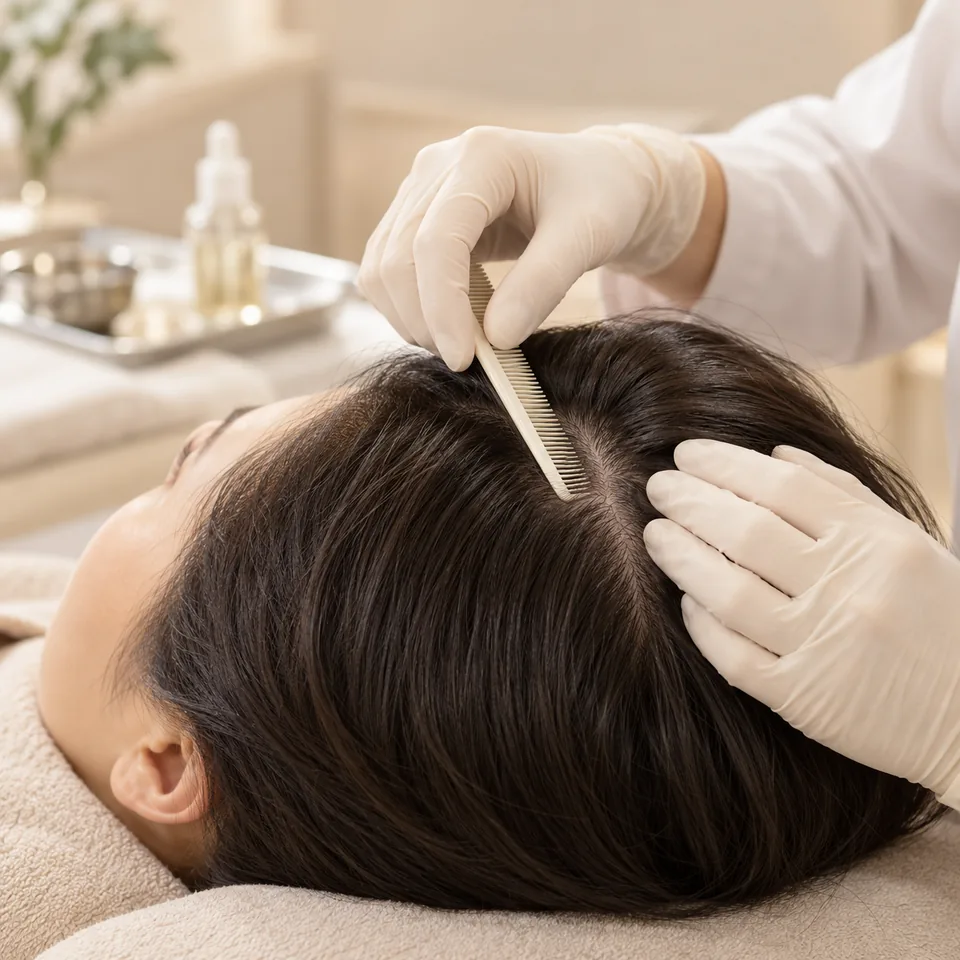
Scalp acupuncture & pharmacopuncture
We explain their suitability and limitations for your scalp condition.

Progress & lifestyle care
We track changes with photos and lifestyle records.
If this is your first visit,here's how it works.
- STEP 01
Treatment history
We hear when symptoms began and about previous treatment.
- STEP 02
Scalp & hair examination
We check skin changes and discomfort.
- STEP 03
Plan & cost
We explain the treatment, care, and visit plan.
- STEP 04
Progress check
We monitor changes in symptoms and daily life.
Please prepare before your visit. Photos from when symptoms were severe, the ointments and medications you use, and any previous test or treatment records will help the consultation. Treatment methods and duration vary depending on the examination results and your individual condition. Herbal medicine, acupuncture, pharmacopuncture, and other treatments can have side effects, so please tell us about existing conditions, medications, allergies, and pregnancy at your visit.
We record changes in your scalp and hair along with your lifestyle
Together we decide on care you can practice, suited to your skin and scalp condition and living environment.
- Check recent changes in diet and weight
- Review stress you put on your scalp and hair
- Tell us about oral and topical medications at your visit
- Record hair changes with photos taken under the same conditions
Find the next step your skin needs with us.
- We will listen to your current discomfort and treatment history, and explain the direction of treatment and care.
References: BAD patient information: Hair loss male pattern (2024), Hair loss female pattern (2024), Alopecia areata (2024), Telogen effluvium (2025), Lichen planopilaris (2022). These refer to the features of each type in the association's guidance and are not a single diagnostic standard for hair loss.
FAQ
For any other questions, please ask when booking your visit.
Do you treat all types of hair loss the same way?
The direction of care differs depending on the form of hair loss, how fast it progresses, and its cause. We check your hair and scalp condition and any previous diagnoses, tests, and treatment, and advise on further evaluation when needed.
Can I consult you while taking hair loss medication?
Yes. Please tell us the names of oral and topical medications you use and how long you have used them. Do not stop your existing prescription or change the dose on your own.
When will I start to see changes?
It depends on the cause and stage of hair loss and the treatment method. Rather than guaranteeing regrowth within a set period, it is necessary to keep checking changes in your hair and scalp over time.
How much does hair loss care cost?
After checking your scalp and hair condition, we explain the cost based on the treatment method and plan needed. If a prescription is needed, we will explain that cost as well.